
INFORMÁCIÓ ÉS AJÁNLATKÉRÉS
INFORMATION AND QUOTATION
Vissza
Home > News > The evolution of closing systems in Hungary

The evolution of closing systems in Hungary

Reynaers-alumínium-nyílászáró-tolóajtó-emelő-toló-ajtó-minimál-homlokzat-lézervágott-lemez-burkolat-terasz-kert-kapcsolat-üveg-építészet-exterior-night
2019 / 03 / 13

If one spends many years in a specialised technical segment, sometimes answering questions from a professional interviewer will inadvertently recall the period from the beginning to the present. Studying the evolution of window and door products used in residential buildings is also instructive, because fashion always changes along with demand and financial opportunities. Everyone sees the past differently – we, Hungarians are special in this – but sales figures outweigh perceptions.

At the beginning of the 90’s, a classic detached house in Hungary had low or medium grade wood, and fewer domestic extruded (and in many cases, yellowing) middle or extreme sealing PVC doors and windows, depending on financial means. The change began around 1995-1996, when serious foreign (mainly German-speaking) window manufacturers and system administrators started selling them in Hungary and then serving them from (sometimes through) a new manufacturing plant in Hungary. Along with the new premium segment that introduced German-speaking manufacturing discipline and its supplier base in Hungary, the domestic lower PVC category also appeared, which was popularly sold on the back of larger wood or plastic products. This new turn brought interesting ratios with new prices and expanded product ranges, namely that the almost monopolistic position of wood products in high-demand residential buildings rolled over and PVC windows and balcony doors became dominant. With its opening methods, variability, production speed, lack of aftercare, meeting thermal insulation and acoustic requirements, and not least with its low prices, PVC was able to provide instant solutions that made it difficult for the wood industry to keep up. However, albeit in small numbers, needs were constantly emerging that could not be sufficiently addressed from this product range. Glass sliding doors, large front doors and conservatories (curtain walls) were already called for by the public building culture, namely in aluminium, as it had the same usability and handling properties as PVC, in addition to the additional value it brings into the feasibility of customer needs. At the same time, the low number of skilled system administrators, “fly-by-night” manufacturers and the dumping of Hungarian “smart” solutions had already annoyed many customers for good reason, and taught many how to value quality and pay for it. At that time, there was not much aluminium work in family houses, but they typically tried to trespass the infinite at that time.
The regional distribution of general window and door sales and the sales results were mainly dependent on the resellers and the customs of the households. Timber manufacturers continued to believe in direct sales (one might still remember the term “ex-works price”), while PVC companies – based on foreign examples – started selling their products in networks and also organised their installation. The reseller mode proved to be more effective because it represented a visible nationwide coverage in the then limited-access Internet world. In addition, the utilisation rate of the manufacturer was more efficient, and it was able to maintain a low price gradually, keeping the largely slow-reacting woodworking industry under constant pressure.

In the 2000s, the number of customers in the premium door and window segment began to grow in Hungary, as Austrian and German manufacturers finally recognised the change in customer and designer needs and the new trends. In the preceding period, the load-bearing capacity of the “new” glazing, typically demanded after the 1973 oil price explosion, determined the size and reinforcement of the structures that could be fabricated (i.e. no increase in size could come into question). In fact, residents of the Bauhaus buildings of the 1930s have happily enjoyed the sunlight let in through the spacious glass walls and high-sliding doors for 40 years. In the early 2000s, new moving solutions were available with good component prices and heavy duty hardware, so despite the different styles, and the diverging need for their exterior and interior appearance, more and more glass walls and sliding doors were sold. There is definitely a European trend of a change in style that is still going on and it seems to remain a permanent process. At the same time (thanks to warming), of course, the issue of shading was also revisited, as larger glass surfaces could often not be handled by the shutters or the blinds that became trendy.
Designer colleagues have also become more bold in terms of sizes and shapes, and have started using the “circle template and the long ruler”. I am not thinking of the former “small mansion” constructions in Buda; rather the more modern, one-storey residential buildings, the use of the flat roof that came back into fashion again, the near-level glass walls and the glass sliding doors. Domestic glass processors were often unable to solve the problem of large glass plates due to the lack of equipment with adequate capacity; at the same time they could put bubble glass templates in stock slowly, as nobody wanted them, and that fashion was the past. The door and window fitters were getting “longer and longer arms” and the glasses were often carried by eight to ten people. The market was shaped and expanded, because Western European products and technologies, new production and transport equipment were immediately available to us. The money-making domestic producers became good end-product intermediaries for this purpose. In the family home market, there was dumping of both shoddy and quality PVC and wooden windows and doors, and one could hardly choose between them. In the PVC windows segment, Polish and Slovakian import products appeared in Hungary at that time, most of which strengthened the lowest category, and only a few Polish factories produced professional work from quality raw materials.
However, the global crisis brought along a brutal clean-up of the segment and the market. Domestic and foreign manufacturers and suppliers dropped out fortunately along with the swindlers too. The previously unprecedented negative “fear of the Polish window” message shocked this already sensitive market. Many customers and professionals have been shaken by this essentially untrue market thesis, thus redirecting premium requests from PVC towards wood products that seemed more reliable. The mid-range has disappeared; requests were received for the cheapest or quality products. The few domestic construction projects came to a halt or became drastically price-sensitive. Only the premium customer base has used quality materials for construction, with a demand for quality. During this period and shortly afterwards, the demanding expectations of domestic builders, developers and designers, still prevalent in Hungary, began to emerge, but these sets still do not have a perceivable real union now at some construction sites. At that time, the demand for a helping professional, a technical executive became fashionable, but perhaps someone still highly recommended He tries to guide the investor through the many mine-traps along the path from developing the design to the handover, so that the architectural concept can be implemented and fit within the budget. Most architectural conventions in window circles were then about rationalising “oversized” windows, because they couldn’t be manufactured. This is where KAV entered. As a new entrant, we alone have recognised that, with the increase in the size of doors and windows, wood and PVC products are no longer able to compete with aluminium structures in terms of quality either. Aluminium premium doors and windows will be the winners. Although today, thanks to aluminium and steel window improvements, this design barrier has almost disappeared; the extra financial need for large sizes (framing, glass, installation costs) is still being underestimated by architects, due to the lack of prior consultation, thus exposing themselves and the developer to serious inconveniences.

We have arrived today to where, after a design consultation, the developers shared their experience with us about requesting a quote in an informal conversation. Then they asked me why we have become an export-oriented company with such domestic references and professional potential, and why they do not see our work in classy buildings in Hungary. For example, they read a lot about our new work in Iceland, our mysterious development programme and our plans. I replied that there are no miracles; the aluminium market has begun to be eclectic like the PVC or wood market once upon a time, along with the former, almost chemically pure premium segment, the “cheap and even cheaper” category began to appear even in this segment. Not surprisingly, given the history of the trade, some Hungarian consumers try their luck again. The shoddy is not our market and those who choose that are not our customers. We are present in the quality segment, and we want to hold our ground there because only the final opinion of our customers matters. Quality buyers and quality professionals are looking for a window manufacturer they can ask the most from and with whom they may even think in the extreme. Unlike others, we assume liability for our aluminium windows, the glasses and our work. Our engineers and manufacturing staff are the best, and we are very proud of them. Apparently, this message touches foreign builders more, and encourages them to work with us on our current, brand-independent product line, and our professionalism, flexibility and vision encourage them to cooperate with us. We deliver to wherever and to whatever customer, worldwide, wherever and to whoever appreciates this. It seems now that, for expansion and significant growth, abroad is apparently an opportunistic solution for us, but we continue to strive to educate the domestic demanding residential customer base and their technical assistants and to serve them with excellent value for money; in other words, we are and will be at home in Hungary.

Author
Lovász Károly
MoreNews
01
020
2017 / 08 / 02
The Vizafogó parish lodge has been renewed with KAV support
The full building structure, energy renovation and functional extension of the St. Martin of Tours parish lodge has been completed. The concept of this building on Váci út in Budapest, serving religious purposes, was developed by the head of our company, Károly Lovász. And although the implementation was performed by others through the public procurement procedure, KAV supported and checked the entire process as professional advisor during the works. We talked about this five year process with Dr Gábor Tamás Juhász, the parish priest
Show more
2019 / 08 / 29
Schüco-alumínium-keret-nélküli-tolóajtó-frameless-slide-door-porsche-design-PD77-minimal-house-exterior-lemezburkolat-lemez-homlokzat-panel
For a smart home, product selection is key
For a newly built property, in terms of windows and doors, one of the most important questions is whether prospective residents would like a building management system in the house, as all solutions need to be tailored to this in the design phase. For today's systems, system-specific connector units and auxiliary modules must already be planned and positioned so that they can remain completely hidden.
Show more
2018 / 11 / 06
Schüco-alumínium-emelő-toló-erkélyajtó-ajtó-ablak-nappali-üveg-építészet-minimal-house-beltér-interior
A timeless house, free from trends and fast fashion
The property was built in the vicinity of water and nature, with full transparency, clarity and harmony as its main features. The house, with its unique shapes, could be completed at a very high standard of quality without making compromises. We spoke about this process with György Pintér, the owner of the house.
Show more
2018 / 12 / 12
kav-closing-systems-also-in-iceland
KAV closing systems also in Iceland
It has been a well-kept secret for a long time, and today many in the facade and structure building business are also talking about KAV’s new undertaking. Aluminium closing system products manufactured according to special customer demands are not only interesting due to their specific technical and weather requirements but also because of the installation location.
Show more
2019 / 06 / 21
Nagy-Zoltán-Reynaers
Finding the right solution for the project
Unlike its other competitors, KAV was not thinking about classic “contract manufacturing” - that is, not buying material from us, making and delivering it, so to speak - but actually looking at the whole project, looking for solutions and providing additional services to the Icelandic customer.
Show more
2020 / 01 / 24
Schuco-aluminium-18-PD-FW50-exclusive-window-sliding-door-glass-roof-interior4
KAV and Porsche design
Taste of life, reliability, design and functionality. These were the buzzwords for designing the minimalist style house, the owner of which followed F. A. Porsche's philosophy.
Show more
2017 / 10 / 30
A minimalistic house with a view that cannot be destroyed
2022 / 02 / 08
Alukönigstahl-alukoenigstahl-ungarn-Eiles-Károly-
THE MARKET SHARE OF ALUMINIUM WINDOWS AND DOORS IS CONTINUOUSLY INCREASING IN RESIDENTIAL PROJECTS
The market share of aluminium and steel doors and windows in Hungary is constantly increasing with regard to single-family home projects as well. However, even in this stable market, the year 2021 introduced a number of unexpected situations: cancelled professional events, shortages of raw materials and supply chain disruptions. We spoke to Károly Eiles, the company's investment and general contracting consultant, about the impressions with which Alukönigstahl Kft. (the distributor of Schüco and Jansen systems in Hungary) closed this challenging year.
Show more
2022 / 04 / 11
Schüco-alumínium-függönyfal-FW50-tolóajtó-Reynaers-slider-door-terasz-emelő-toló-ajtó-üvegfal-CLT-2
Those about whom who nobody ever talks, or the eminences of manufacturing preparation
KAV's customers come into contact with several of our colleagues in the bidding, preparation and construction processes in the course of a job. These are our sales and estimation colleagues, our technical and manufacturing preparation engineers, our project engineers, and then our installation specialists. It is very rare that the end-user comes into contact with the manufacturing preparation engineers. In this article, we’d like to describe the work of these professionals in connection with the Continental Golf Club construction project.
Show more
2017 / 09 / 05
We build for the future rather than for today
Clear shapes, large glass surfaces, spacious interior spaces and creative use of materials – these are the main features of the most predominant architectural style of our era, minimalistic design, in which interest is outstanding in Hungary. However, the number of really well designed and built minimalistic family homes is relatively low. The property our engineers consider as one of the best designed ones our company has met in recent years was built in Budapest. During the project we paid increased attention to the design of large, liberally designed glass surfaces, essential for creating open spaces. We had a conversation with the developer of the house about what was needed to create this property.
Show more
2022 / 07 / 04
Aluta-Nívódíj-2022-KAV
The ALUTA awarded two KAV buildings
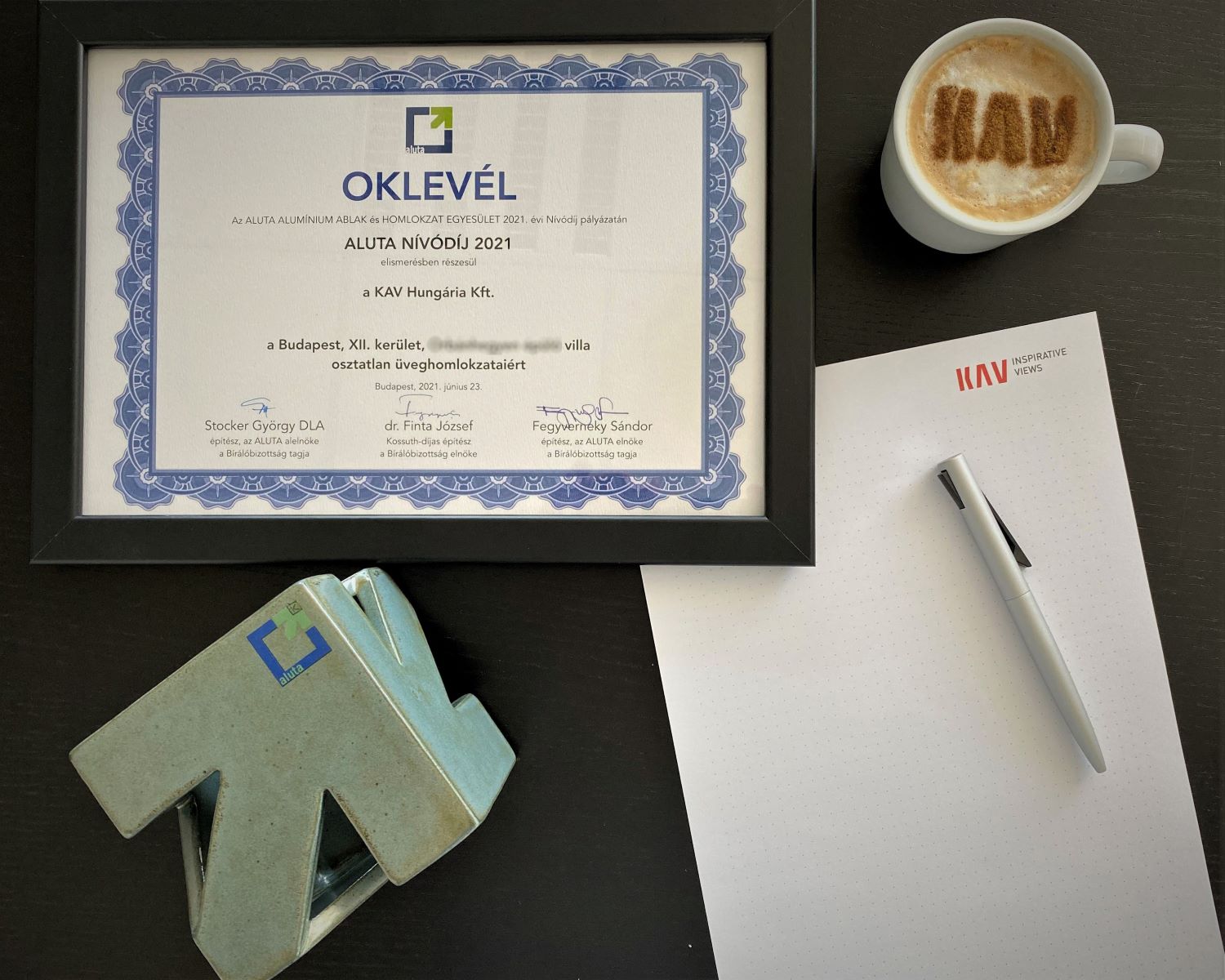
After the successes of recent years, this year two KAV buildings were honored with the only recognition of Hungarian aluminum door and façade manufacturers, ALUTA Nívódíj. In the small project category, which includes residential buildings, the KAV project "Költőkert" in Mártonhegy, Budapest, was awarded the ALUTA Nívódíj. In the large foreign project category, our solutions for the Marriott Hotel in Iceland were recognized.
Show more
2019 / 11 / 28
dubai-the-city-of-superlatives
Dubai, the city of superlatives
Dubai is now the world's fastest-growing city; one that was built up over several decades, almost from scratch. Here you will find the world's tallest building, the Burj Khalifa, 828 metres high; its airport is often called the most dynamic and artificial islands and breath-taking architectural structures attract millions of tourists to the city every year. The continuously growing Dubai will also be the venue for the 2020 Expo. This year, the professional path of the 20-year-old professional association, ALUTA, led to this metropolis presenting innovative architectural trends.
Show more
2019 / 04 / 08
Three KAV buildings received the ALUTA Award of Excellence
After the successes of the past two years, three KAV buildings were awarded with the ALUTA award of excellence, the only quality recognition of Hungarian aluminium window, door, facade manufacturers, in the “small project”, i.e. residential building, category.
Show more
2020 / 04 / 08
The Architect needs to think with the door and window specialist
People at KAV can think together with the project, suggesting fancy solutions that often go beyond installation instructions. They think about it, add some parts that make a door trendy, no matter how strange it sounds at first. They feel the fine details that need to be put into it. They can think together with their architect colleague.
Show more
2018 / 03 / 12
Every property is sold once
By now, a personal needs assessment by an engineer has become the trademark of our company. We facilitate this process, in that our customers who request a quote may decide on the question of closing systems on the basis of an objective and clear set of requirements.
Show more
2020 / 07 / 23
Schuco-aluminium-17-PD-FW50-exclusive-window-sliding-door-glass-roof-interior3
Clean shapes, large glass surfaces
In the exclusive family-home market, connection with the environment and the transparency that enables it have clearly become the most important factors in the domestic and international trends in custom doors and windows. On behalf of Etna Kft., KAV is participating in the construction of a building with three fully glazed facades. We talked about that special project and the most important directions of the sector with Nikos Zisidis, the executive manager of the client company.
Show more
2023 / 03 / 30
Reynaers-hifinity-minimal-interior-kitchen-glass-frame-sliding-door-luxury
Do we need large glass surfaces everywhere?
Our colleagues are increasingly encountering residential building plans in which large glass surfaces dominate. These concepts are understandable not only from a design perspective but also because of transparency, connection with the environment, and the continuous influx of light. However, in many cases, they cannot be realized, or they require significantly higher investments and more complex alterations to the plans. In our new series, we explore the topic of the dimensions of glass surfaces with Mr. Károly Lovász, the CEO of KAV, and Mr. Csaba Mravik, the Chief Development Engineer.
Show more
2022 / 05 / 26
Farkas-Gábor-Sika-Magyarország
Aluminium windows and doors and the gluing technique
Unique windows and doors, large glass surfaces and narrow frames would not have become part of our building culture without developments in gluing technology. We talked to Gábor Farkas, head of the industrial glue technology division at Sika Hungária Kft., about the special fixing and sealing processes and innovations that have emerged in this field over the past decade. The cooperation between KAV and Sika goes back many years. In the beginning, they only supplied sealing materials for glass-to-glass connections made on-site, but today they supply KAV's factory workers and installation team with special materials and tools, and also train our engineers.
Show more
2023 / 05 / 15
Reynaers-aluminium-nyilaszaro-Kenyeres-Laszlo-epitesz-latvanyterv
The Role of Windows in the Design Process, an Architect’s Perspective
Kenyeres László, a leading architect at the Archista architectural firm, believes that villa buildings can be considered small form factor public buildings. This is why he considers it crucial to consult with window and door specialists multiple times during the design process. This approach helps avoid situations where window and door companies have to "re-design" certain parts of the building during the construction phase.
Show more
2023 / 01 / 26
Schüco-alumínium-tolóajtó-ablak-emelő-toló-KAV-üveg-üveg-sarok-Schlotterer-80D-raffstore-minimal-house-kültér-udvar-terasz-exterior-4
The issue of shading is becoming increasingly important
The changing economic environment and rising energy prices are also impacting the construction industry. But how might the market for premium segment windows change? According to KAV's CEO, Károly Lovász, the focus will shift towards the issue of shading, and it is crucial for builders to select companies with a stable background and a qualified workforce.
Show more