INFORMÁCIÓ ÉS AJÁNLATKÉRÉS
INFORMATION AND QUOTATION
Vissza
Home > News > The evolution of closing systems in Hungary

The evolution of closing systems in Hungary

Reynaers-alumínium-nyílászáró-tolóajtó-emelő-toló-ajtó-minimál-homlokzat-lézervágott-lemez-burkolat-terasz-kert-kapcsolat-üveg-építészet-exterior-night
2019 / 03 / 13

If one spends many years in a specialised technical segment, sometimes answering questions from a professional interviewer will inadvertently recall the period from the beginning to the present. Studying the evolution of window and door products used in residential buildings is also instructive, because fashion always changes along with demand and financial opportunities. Everyone sees the past differently – we, Hungarians are special in this – but sales figures outweigh perceptions.

At the beginning of the 90’s, a classic detached house in Hungary had low or medium grade wood, and fewer domestic extruded (and in many cases, yellowing) middle or extreme sealing PVC doors and windows, depending on financial means. The change began around 1995-1996, when serious foreign (mainly German-speaking) window manufacturers and system administrators started selling them in Hungary and then serving them from (sometimes through) a new manufacturing plant in Hungary. Along with the new premium segment that introduced German-speaking manufacturing discipline and its supplier base in Hungary, the domestic lower PVC category also appeared, which was popularly sold on the back of larger wood or plastic products. This new turn brought interesting ratios with new prices and expanded product ranges, namely that the almost monopolistic position of wood products in high-demand residential buildings rolled over and PVC windows and balcony doors became dominant. With its opening methods, variability, production speed, lack of aftercare, meeting thermal insulation and acoustic requirements, and not least with its low prices, PVC was able to provide instant solutions that made it difficult for the wood industry to keep up. However, albeit in small numbers, needs were constantly emerging that could not be sufficiently addressed from this product range. Glass sliding doors, large front doors and conservatories (curtain walls) were already called for by the public building culture, namely in aluminium, as it had the same usability and handling properties as PVC, in addition to the additional value it brings into the feasibility of customer needs. At the same time, the low number of skilled system administrators, “fly-by-night” manufacturers and the dumping of Hungarian “smart” solutions had already annoyed many customers for good reason, and taught many how to value quality and pay for it. At that time, there was not much aluminium work in family houses, but they typically tried to trespass the infinite at that time.
The regional distribution of general window and door sales and the sales results were mainly dependent on the resellers and the customs of the households. Timber manufacturers continued to believe in direct sales (one might still remember the term “ex-works price”), while PVC companies – based on foreign examples – started selling their products in networks and also organised their installation. The reseller mode proved to be more effective because it represented a visible nationwide coverage in the then limited-access Internet world. In addition, the utilisation rate of the manufacturer was more efficient, and it was able to maintain a low price gradually, keeping the largely slow-reacting woodworking industry under constant pressure.

In the 2000s, the number of customers in the premium door and window segment began to grow in Hungary, as Austrian and German manufacturers finally recognised the change in customer and designer needs and the new trends. In the preceding period, the load-bearing capacity of the “new” glazing, typically demanded after the 1973 oil price explosion, determined the size and reinforcement of the structures that could be fabricated (i.e. no increase in size could come into question). In fact, residents of the Bauhaus buildings of the 1930s have happily enjoyed the sunlight let in through the spacious glass walls and high-sliding doors for 40 years. In the early 2000s, new moving solutions were available with good component prices and heavy duty hardware, so despite the different styles, and the diverging need for their exterior and interior appearance, more and more glass walls and sliding doors were sold. There is definitely a European trend of a change in style that is still going on and it seems to remain a permanent process. At the same time (thanks to warming), of course, the issue of shading was also revisited, as larger glass surfaces could often not be handled by the shutters or the blinds that became trendy.
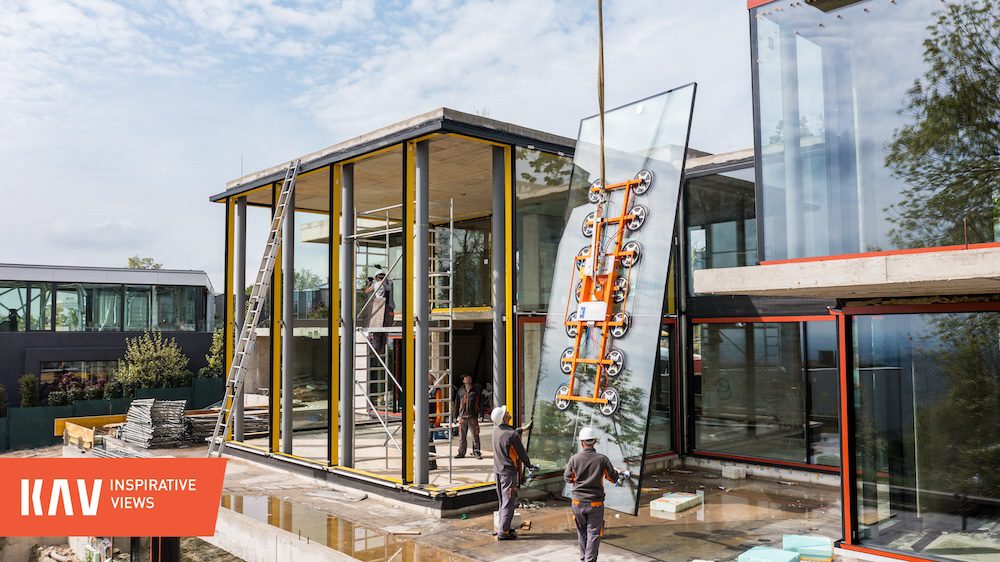
Designer colleagues have also become more bold in terms of sizes and shapes, and have started using the “circle template and the long ruler”. I am not thinking of the former “small mansion” constructions in Buda; rather the more modern, one-storey residential buildings, the use of the flat roof that came back into fashion again, the near-level glass walls and the glass sliding doors. Domestic glass processors were often unable to solve the problem of large glass plates due to the lack of equipment with adequate capacity; at the same time they could put bubble glass templates in stock slowly, as nobody wanted them, and that fashion was the past. The door and window fitters were getting “longer and longer arms” and the glasses were often carried by eight to ten people. The market was shaped and expanded, because Western European products and technologies, new production and transport equipment were immediately available to us. The money-making domestic producers became good end-product intermediaries for this purpose. In the family home market, there was dumping of both shoddy and quality PVC and wooden windows and doors, and one could hardly choose between them. In the PVC windows segment, Polish and Slovakian import products appeared in Hungary at that time, most of which strengthened the lowest category, and only a few Polish factories produced professional work from quality raw materials.
However, the global crisis brought along a brutal clean-up of the segment and the market. Domestic and foreign manufacturers and suppliers dropped out fortunately along with the swindlers too. The previously unprecedented negative “fear of the Polish window” message shocked this already sensitive market. Many customers and professionals have been shaken by this essentially untrue market thesis, thus redirecting premium requests from PVC towards wood products that seemed more reliable. The mid-range has disappeared; requests were received for the cheapest or quality products. The few domestic construction projects came to a halt or became drastically price-sensitive. Only the premium customer base has used quality materials for construction, with a demand for quality. During this period and shortly afterwards, the demanding expectations of domestic builders, developers and designers, still prevalent in Hungary, began to emerge, but these sets still do not have a perceivable real union now at some construction sites. At that time, the demand for a helping professional, a technical executive became fashionable, but perhaps someone still highly recommended He tries to guide the investor through the many mine-traps along the path from developing the design to the handover, so that the architectural concept can be implemented and fit within the budget. Most architectural conventions in window circles were then about rationalising “oversized” windows, because they couldn’t be manufactured. This is where KAV entered. As a new entrant, we alone have recognised that, with the increase in the size of doors and windows, wood and PVC products are no longer able to compete with aluminium structures in terms of quality either. Aluminium premium doors and windows will be the winners. Although today, thanks to aluminium and steel window improvements, this design barrier has almost disappeared; the extra financial need for large sizes (framing, glass, installation costs) is still being underestimated by architects, due to the lack of prior consultation, thus exposing themselves and the developer to serious inconveniences.

We have arrived today to where, after a design consultation, the developers shared their experience with us about requesting a quote in an informal conversation. Then they asked me why we have become an export-oriented company with such domestic references and professional potential, and why they do not see our work in classy buildings in Hungary. For example, they read a lot about our new work in Iceland, our mysterious development programme and our plans. I replied that there are no miracles; the aluminium market has begun to be eclectic like the PVC or wood market once upon a time, along with the former, almost chemically pure premium segment, the “cheap and even cheaper” category began to appear even in this segment. Not surprisingly, given the history of the trade, some Hungarian consumers try their luck again. The shoddy is not our market and those who choose that are not our customers. We are present in the quality segment, and we want to hold our ground there because only the final opinion of our customers matters. Quality buyers and quality professionals are looking for a window manufacturer they can ask the most from and with whom they may even think in the extreme. Unlike others, we assume liability for our aluminium windows, the glasses and our work. Our engineers and manufacturing staff are the best, and we are very proud of them. Apparently, this message touches foreign builders more, and encourages them to work with us on our current, brand-independent product line, and our professionalism, flexibility and vision encourage them to cooperate with us. We deliver to wherever and to whatever customer, worldwide, wherever and to whoever appreciates this. It seems now that, for expansion and significant growth, abroad is apparently an opportunistic solution for us, but we continue to strive to educate the domestic demanding residential customer base and their technical assistants and to serve them with excellent value for money; in other words, we are and will be at home in Hungary.

Author
Lovász Károly
MoreNews
01
020
2019 / 05 / 16
Reynaers-aluminium-emelo-tolo-ajto-ablak-uveg-homlokzat-burkolat-Schlotterer-92Z-Raffstore-zsaluzia-minimal-house-terasz-lepcso-gyep-kert-kulter-exterior
The evolution of blinds
Climate change and increasingly sophisticated customer demands have accelerated the evolution of shading systems, not just of windows and doors. While in the past the goal was complete darkening, nowadays light control and maximum transparency are the main considerations. Thanks to this, most client choose lamellar and textile shadings.
Show more
2017 / 10 / 30
A minimalistic house with a view that cannot be destroyed
2022 / 09 / 01
The key to the realisation of large-scale glass structures is thinking together
Huge glass structures are definitive elements of modern buildings. It is therefore especially important that architects create the plans while thinking together with sector designers. On the questions arising while designing and constructing glass façades, we spoke with chartered architect György Mihály Stocker, reader in the BUTE and vice-president of ALUTA, who played an outstanding role as specialist consultant in the construction of the Hungarian House of Music in its present form.
Show more
2020 / 04 / 21
Schuco-Reynaers-aluminium-window-door-slide-glass-interior-fassaden-night3-k
A refined aesthetic for doors and windows
The popularity of the minimalist style in architecture is one of the reasons that aluminium doors and windows entered the family house sector. Applying the principle of “less is more” to architecture led architects and designers to use unique solutions and austere or transparent surfaces. In a minimalist home, simple shapes and forms help create an atmosphere of harmony, where space itself serves humanity.
Show more
2023 / 06 / 29
Nagy üvegfelületű alumínium nyílászárók beépítése
The Art of Installing Large Glass Panels: A Technical Journey with KAV
In recent times, we have shared several recordings depicting the installation process of large glass surfaces as part of KAV's daily operations. To shed light on the distinctions in window installation and preparation when incorporating larger glass sizes into a property compared to standard glass dimensions, we interviewed Mr. Péter Nagy, Senior Engineer, and Mr. Károly Lovász, CEO of KAV.     
Show more
2019 / 01 / 09
Schüco-alumínium-keret-nélküli-tolóajtó-PD77-slide-door-frameless-üvegfal-üveg-üveg-sorolás-nappali-beltér-interior-night
Reflecting the environment with closing systems
The KAV approach helped a lot in its implementation. They talk to the customer and they don't want to sell a product, they want to answer questions and look for a solution. I did not have to choose from a catalogue, so I was not forced to choose from a set of solutions, but was offered individual solutions to a given problem. Of the companies I worked with, KAV gave me the most technical support.
Show more
2022 / 09 / 22
Schuco-aluminium-emelo-tolo-erkelyajto-ajto-ablak-nappali-dolgozo-szoba-uveg-epiteszet-minimal-house-belter-interior
The Basics of Doors and Windows – A Conversation with Architect György Hoffmann
Huge, transparent surfaces that create almost a direct connection with the surroundings. Architect György Hoffmann believes that in modern architecture, there is no longer a need for walls, as windows and pillars can also fulfill the structural functions. Our conversation also reveals what primarily influences the thinking of architect-designers and what it takes to establish a common language between the client and the designer.
Show more
2022 / 08 / 11
Schüco-alumínium-ferde-szemöldök-alakos-külső-napvédelem-nyílászáró-Schlotterer-raffstore-lamellás-árnyékoló-motoros-rejtett-geometria-exterior_
The market for shading in Hungary
Although, in the past, residential properties tended to be built in Hungary without shading, today it is a priority in the design process. Due to climate change, it is just as important for property to provide an optimal thermal performance in the summer period as it is during winter. For this reason, KAV began designing customised shading. Of course, when introducing an innovation, we need to take into account the nature of the Hungarian market. KAV’s Managing Director, Károly Lovász, talks about the most exciting developments.
Show more
2021 / 09 / 16
leica-3d-szkenner
3D scanner for the most accurate design, manufacture and installation of aluminium doors and windows
Prior to manufacturing aluminium doors and windows, KAV’s staff pay special attention to the technical preparation and professional planning. In order to have the most detailed information possible (not only for our employees, but also for our customers) we have expanded our instrumentation with one of the most modern 3D scanners. We talked to Péter Nagy, one of KAV's project engineers, about how the instrument works and what kind of information it provides to helps the work of the various trades.
Show more
2017 / 12 / 20
Ethical operations raise even SMEs to the top
Following the large enterprise sector, operating ethically is becoming increasingly important for small and medium-sized enterprises, too. These companies not only take into account the interests of their clients and suppliers but also those of their environment and employees. They set an example by their activity and attitude and strengthen trust. This attitude may constitute a basis for long-term operation and economic stability, and what is more, employees of the Y and Z generations are more eager to opt for an ethically operating workplace.
Show more
2022 / 05 / 26
Farkas-Gábor-Sika-Magyarország
Aluminium windows and doors and the gluing technique
Unique windows and doors, large glass surfaces and narrow frames would not have become part of our building culture without developments in gluing technology. We talked to Gábor Farkas, head of the industrial glue technology division at Sika Hungária Kft., about the special fixing and sealing processes and innovations that have emerged in this field over the past decade. The cooperation between KAV and Sika goes back many years. In the beginning, they only supplied sealing materials for glass-to-glass connections made on-site, but today they supply KAV's factory workers and installation team with special materials and tools, and also train our engineers.
Show more
2020 / 08 / 25
Schüco-sonder-egyedi-fejlesztésű-üveg-optikás-alumínium-nyílászáró-optivision-KAV-Hungária-Aluminium-2
With innovation, there is a solution to every issue
The changing needs of customers and architects require continuous innovation in the field of aluminium door and window systems, too. One of the basic ideas of KAV's operation is that we believe that there is a solution to every issue. Of course, we also work in this spirit during our developments. The KAV Optivision system was created with the professional support of Alukönigstahl. Together with the company's sales representative, Gábor Kiss, we are looking for answers to those frequently asked questions that can be solved using existing products.
Show more
2022 / 04 / 11
Schüco-alumínium-függönyfal-FW50-tolóajtó-Reynaers-slider-door-terasz-emelő-toló-ajtó-üvegfal-CLT-2
Those about whom who nobody ever talks, or the eminences of manufacturing preparation
KAV's customers come into contact with several of our colleagues in the bidding, preparation and construction processes in the course of a job. These are our sales and estimation colleagues, our technical and manufacturing preparation engineers, our project engineers, and then our installation specialists. It is very rare that the end-user comes into contact with the manufacturing preparation engineers. In this article, we’d like to describe the work of these professionals in connection with the Continental Golf Club construction project.
Show more
2021 / 07 / 08
Aluta-Nívódíj-2021-KAV
KAV was given an award in the aluminium door and window small project category
This year, the Aluminium Window and Façade Association (ALUTA) awarded its prizes again. KAV’s work was again given an award in the small project category, with the only prestigious recognition by the Hungarian aluminium door and façade manufacturers.
Show more
2019 / 02 / 07
Rebirth of a Bauhaus villa
This year, the Bauhaus is 100 years old, and it is a great pleasure for us to take part in the renovation of a property displaying the marks of this school. When the Bauhaus appears as a description of a building, it is a guarantee of clean shapes, exciting spaces and quality materials. Even so, it is important to point out that although several Hungarian architects were in contact with the famous German school, there are hardly any Bauhaus buildings, in the strict sense, in Budapest. Péter Lenzsér, the architect, talked about how this building bears the hallmarks of style and how it is worth embarking on such a renovation.
Show more
2017 / 05 / 10
KAV is amongst the most excellent companies in Hungary
KAV Hungária was awarded a prize in the Innovation and Ongoing Perfectioning and the Culture of Recognition categories in the Hungary’s Most Excellent Companies Award Programme.
Show more
2021 / 01 / 14
Csóti-Gábor
Aluminium doors and windows and a flexible business model
As a company specialised in custom doors and windows, KAV is constantly striving for innovation and renewal, while maintaining the values it is worth building on. As a member of the Gamechangers professional community, we strive to share best business and organisational practices. We talked to the founder of the initiative, Gábor Csóti, about how the coronavirus epidemic has changed the operation of businesses and
Show more
2020 / 03 / 18
custom-windows-and-doors-beyond-the-standards
Custom windows and doors beyond the standards
Just as in many areas of the world, ‘unique’ and ‘self-expression’ are the strongest buzzwords; so change the needs of architects and developers. However, most door and window manufacturers are finding it difficult to go beyond the standard items, although this area also offers many innovations in the field of architecture when it comes to sincerely rethinking structures.
Show more
2022 / 03 / 21
Schüco-alumínium-függönyfal-FW50-tolóajtó-Reynaers-slider-door-terasz-emelő-toló-ajtó-üvegfal-CLT-1
Aluminium door and window systems for a golf club extension
From almost the first pencil stroke, KAV's staff cooperated with Kroki Studio on the extension of the Continental Golf Club. This included a jointly designed support structure, custom latched line-up and skylight connections, amongst other elements of the exclusive building. We spoke to András Göde, one of the founders of Kroki, about the joint work, what it is like to work on the basis of each other's ideas and the interesting aspects of the project.
Show more